Showing posts with label pitch. Show all posts

Thursday, October 9, 2014

Red Pine Tree


PINE TREES


PART 2

Red Pine Tree

 
The red pine tree is another species of pine found in the northern half of the USA.  It is also known as the Norway Pine Tree.
 
 Red pine trees reach 80-85 feet.  With a diameter of 1 1/2-3 feet.

The bark of a red pine tree is reddish- brown.
 
More scaly as it ages...
 
The needles of a red pine are 5 inches. 

 The red pine has long needles, but only two sharp needles in a bunch.  (Unlike the white pine containing five.)
 
Cones of red pines are 2-3 inches long.
 
There are many uses for the red pine.
Three of these are railroad ties, telephone poles, and mining  timbers.

Diseases or harmful things of red pines are not only critters, but...

as with all conifers armillaria rot or "wet root rot" is a possibility.  However, red pines with well drained soil are less likely to suffer from this disease.


Animals that thrive in pines are squirrels...
 
 all different kinds of birds...

bugs, snakes, and any other animal seeking shelter from brutal winters, extreme heat or safety coverage.

I enjoy finding squirrels in the red pines.


Tree of Study Links:
Pines
White Pine
Red Pine
Jack Pine
Ponderosa Pine
Sugar Pine
Hemlock
Blue Spruce


Thursday, October 2, 2014

White Pine Tree


PINE TREES

PART 1

White Pine Tree


The white pine tree is the tallest pine tree in the USA.  The height of a white pine in full maturity has been known to reach 230 feet tall.  That makes the Eastern White Pine the tallest in the northeast.  The tallest tree in Michigan is known to be 157 feet.  Making it the tallest tree in the 8 state radius.
 
The white pine is also called the Weymouth pine.
The white pine is used for many things.  The most common use for the white pine is its lumber.  It is trucked to sawmills and made into wooden slabs.  The lumber is a white color. 
 
http://www.gophoto.us/key/white%20pine%20tree%20bark
 
White pine bark is smooth and silvery when young.  In the picture above you can notice a more mature tree bark.  The trunk has a dark or "blackish" look to it.  Like all pine trees the inner bark is used in Native American medicine.
 
The average width (diameter) of a White Pine is 3-5 feet.


http://imgarcade.com/1/white-pine-tree-needles/
 
So to see if you can spot a white pine you need to find a coniferous tree with a set of 5 needles.  The needles are 2-5in long.
 
 The white pine is beautiful species of tree, it is my favorite.  So many animals benefit from white pines.  We also tend to see large raptor birds and eagles perched on their large branches.  
 
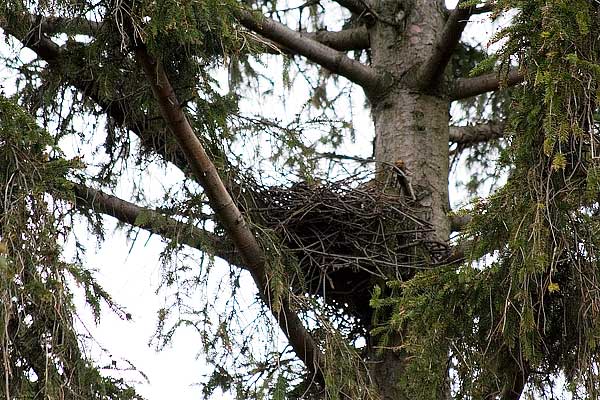
Raptor Nests...
http://www.ccfew.org/assets/images/Coopers_Hawk_nest.jpg
(Cooper's Hawk nest)
Eagles nest and perch...
 
Hawk's nest and scan the area for prey...
https://c1.staticflickr.com/9/8499/8275932909_0f53d51c23_z.jpg
 
 
  The pine cones are 6-8 inches long.  From a distance in a group of pine trees the white pine tree looks darker than the rest.   
http://bio8.wikispaces.com/d)+Classification+of+Life
 
There are two things that I know of that can kill a white pine. And those two things are a pine weevil and blister rust.
 
On your next drive or hike, see if you can spot this magnificent pine tree.


***Mom Notes***
 
The White Pine happens to be Maine's State Tree so HERE is a free coloring page of the white pine.  Look at a few of our projects here of the white pine.


Tree of Study Links:
Pines
White Pine
Red Pine
Jack Pine
Ponderosa Pine
Sugar Pine
Hemlock
Blue Spruce